Being New Photography 2018 at Moma New York Art in America
Existence: New Photography 2018
Iteration 2018 of MoMA'south biennial sampling of what'due south trending in photography rethinks both the pregnant of what it is to exist man and the essential nature of the medium itself
Museum of Modern Fine art, New York
eighteen March – 19 August 2018
by JILL SPALDING
All those years of my early career at British Vogue I had worked adjacent to (and on travel shoots with) the top of what were then, by definition, fashion photographers. I remember marvelling at how well they executed the narrative'south brief; crisp black and whites for Paco Rabanne'southward hard-edged line, dreamy pastels for Zandra Rhodes's wispy creations, neons for the madcap cutups lining Carnaby Street. I recall, too, the wonder of Norman Parkinson's staged scenarios – who will ever forget that shot of Veruschka, tanned, oiled and stretched out on the snow? But not ever did I call back of those magazine fantasies as fine art, nor even Helmut Newton's sexualised fashion-disguised body shoots that sold out every issue they appeared in. Did I ever retrieve to save the proofs of the Cecil Beaton, David Bailey, Herb Ritts, Barry Lategan shoots I had deputed? Although some rose above all the others, none reached the stratosphere of what nosotros called art. These were manner shoots, after all, and fashion itself was merely ephemera, a vanity of the moment.
I confess that this prejudice slipped over to the photograph-journalists I came to know afterward. Searing, those war pictures by Robert Capa! Rousing, those street-takes by Henri Cartier-Bresson, Martine Franck'south poignant portraits of the bypassed and elderly. I call up, besides, when I first saw the volume recording the loftier-low moment of MoMA's footing-splitting 1955 survey The Family of Human. (A happy coincidence that the museum has just reissued it, together with a scholarly catalogue assay of the show's unrivalled impact – it beat out even Male monarch Tut with a largest-always nine million global viewership.) No contest. Here were deeply involving pictures of a visceral America – farmers, barbers, shopkeepers and postal workers finding love, fighting anomie and grinding through the Depression, all in information technology together, trapped in bister by the storied likes of Dorothea Lange and Ansel Adams. Gladdening, saddening, wrenching, but, for those of us brought upward to write Art with a majuscule, the image was still only "defenseless", the salient talent that of close observation not creation.
As for the 24-hour interval'south studio photography, all idea Penn's still life takes on lipstick and flowers gorgeous – cut out of back issues, we would use them for book covers – and admired his portraits. Richard Avedon, who famously said that a likeness transformed by a photo is not a fact just an opinion, imparted a candid intimacy to portraiture that tore through the pages like the outset day of spring. But those proofs? No 1 kept them. (Faddy's photo archive was established but decades afterwards.) Even the carefully positioned and lit photographs past the likes of bona fide artists such as Edward Steichen and Human Ray struck me as experiments – time-off investigations into how to revive their painting and sculpture. Their luminescence was never questioned. Only their value. As understood then, the genius of a great photo was to recalibrate the tired eye. But fine art? Art was feeling! Art was tactile! Painting was Art; sculpture was Art; click-and-print works on paper remained clever exercises in seeing.
Not so fast-frontwards through William Eggleston's saturated dye-transfer takes on American bourgeoisie that introduced colour photography every bit a serious medium; Nan Goldin's wrenching psychedelic photo-journals of lives torn and wasted; Thomas Struth'south magnified manipulations of venues we all had trouped through. All were skilful and not without talent, merely left a nagging sense of "they fix information technology upward, framed it and pressed the push". Still no agreement of what art had to practise with information technology. Shouldn't fine art flow from mind and centre through the mitt? Must not the artist shape, carve, piece or limn a work? Galleries didn't call back then. And, equally prices for a Robert Mapplethorpe leapt from $500 (£350) to $5,000 and those for a Human being Ray rivalled a Rembrandt, nor did the museums. Marcel Duchamp had flipped the model with his urinal; if it hangs in a museum, "information technology'due south art".
For myself, although I never noted the turning point, the needle moved upward with the starting time elaborate interventions. John Baldessari'southward collaged and airbrush "doctored" tabloid photos; James Casebere's newspaper reconstructions, carefully shaped, lit and photographed to convey the clangorous ruins of time. Andreas Gursky's computer-perfected hyperreal panoramas; Vera Luter's 24-60 minutes-exposure transformations of postcard sites into opera sets; David Hockney'due south multiperspective collaged Polaroids. Wondrous those carefully built-upwardly compilations past Gilbert and George; Wolfgang Tillmans' fluid abstractions; Louise Lawler's reworked images scaled up to murals or downwards to paperweights to give them multiple lives; Ahmed Mater's manipulated landscapes, reimagined and rephotographed to advise an irretrievable paradise, and Richard Koci Hernandez's iPhone scenarios that sliced off surreal takes on an ordinary twenty-four hours.
A generational shift has brought yet bolder manoeuvres; photograph/video mashups, digital baloney and the acrobatics performed to simulate texture by applying paint, cloth, food to the original prototype – each intervention photographed and layered on the preceding one to build upward an illusion that, nonetheless, restricted to one plane behind glass, remained ii dimensional. Art? Could be.
This long lead-in is to pinpoint the needle's total swing as offered by this iteration of MoMA'southward two-yearly do in new photography. E'er of keen interest in that information technology reflects the museum's curatorial thinking about what is happening now of note in the medium, the show is e'er well attended, conscientiously reviewed and, relating to its effect on the sales of those included, a trend-setter.
Edition 2018 accommodates 80 new works and, as is now mandatory, a salubrious diverseness. The widened spectrum of nationality, ethnicity and gender encompasses nine countries and extends our belated appreciation of the African-American sensibility to the African continent. In line with MoMA'due south practice to theme each iteration, this year'due south header is "Existence", a broad catch-all for work that "captures what information technology means to be homo". Fortunately, a qualifier adds that "many challenge the conventions of photographic portraiture" considering this selection, compared with the astute intimacy showcased in Existent Worlds; Brassaï, Arbus, Goldin (showing until three September at the Los Angeles Museum of Contemporary Art) presents every bit deliberately detached.
More compelling is MoMA banana curator Lucy Gallun'southward larger proposal that photography has made a significant jump into, if non a new era, a dramatically wider understanding of where a photograph can go. Into the bathwater with the tintype and gum bichromate on platinum take gone Ektacolor and the lightbox transparency. Sinking, also, are the film stocks and analogue cameras that produced them. It is not clear to me whether the digitally powered medium replacing them should even exist idea of as photography. Every bit exhibited here for the nigh part, the initial prototype, equanimous largely with the tools of cut, paste and save, and transformed seemingly advertisement infinitum by reckoner interventions, has been worked into another reality birthday.
Not all has been jettisoned – the silvery gelatin print seems to be making a comeback – and those portraits fix against Photoshopped backgrounds are real people. Rather, unleashed past applied science, it is the artist's eye that has moved. Engaging the Jasper Johns mantra "Do something to information technology. Do something else to information technology", much of this new work has nudged the medium forward with skills that call on virtual realities and artificial intelligence.
The master business concern remains pictorial. And at that place is no getting abroad now from "issues", so race, sexuality, inequality and repression are all addressed here. But the larger achievement of this mastered engineering science is a circuitous artful that subsumes agenda to an expression of universal truths that, as seen in a fair portion of the works on view, can only be chosen art.
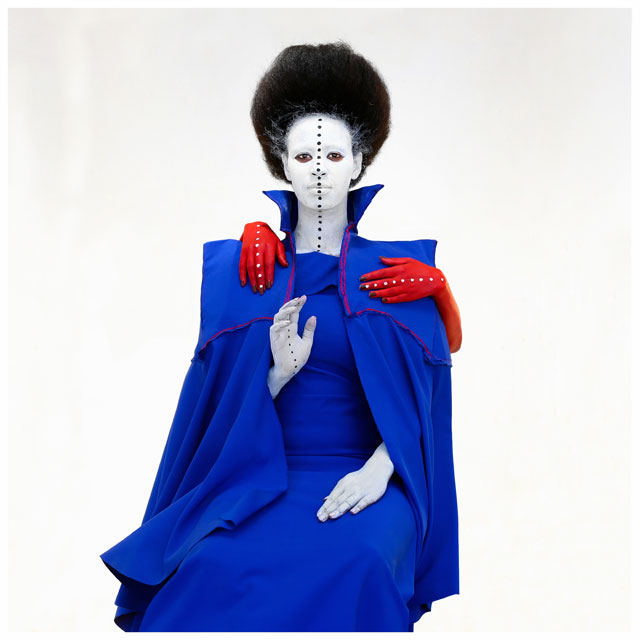
Aïda Muluneh. All in One, 2016. Pigmented inkjet print, 31 1/2 × 31 ane/2 in (80 × 80 cm). Courtesy the artist and David Krut Projects. © 2018 Aïda Muluneh.
Their ages ranging from 31 to 44, but 17 artists accept been tapped, merely each is given a large infinite and multi-work voice. Printing on Sunset Hot Press Rag, Aïda Muluneh (b1974, Federal democratic republic of ethiopia) leads in with elaborately costumed portraits that appoint face paint and razzled backdrops to evoke native African ceremonials. Every bit with a colour-field painting, the punch comes from the contrast of hot and cool as émigré angst spools out from a diptych of a passerby on a train (The Departure 2016) and a sequence of brilliant print-stills to project the impassive dignity of the Masai warrior.
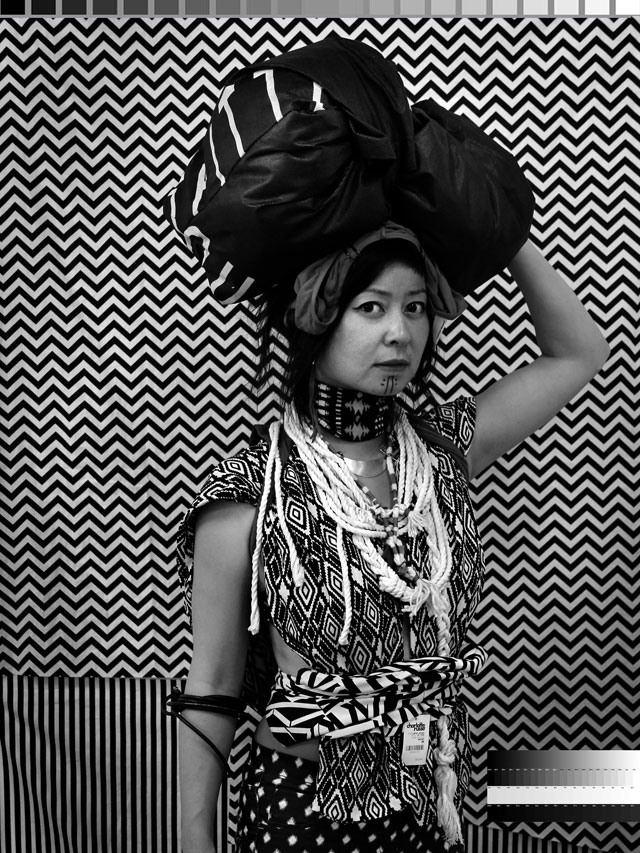
Stephanie Syjuco. Cargo Cults: Head Bundle, 2013-16. Pigmented inkjet impress, twoscore 10 thirty in (101.6 x 76.2 cm). Courtesy the artist and Catharine Clark Gallery, San Francisco and Ryan Lee Gallery, New York. © 2018 Stephanie Syjuco.
Stephanie Syjuco (b1974, Philippines), too, sets costumed portraits against digitally rendered backdrops, but to reverse consequence. Challenging the authenticity of the west's agreement of ethnicity, her 2013-xvi Cargo Cults sendups of travellers' ethnographic depictions (achieved with new garments however showing the price tag, both to flag the conceit and permit her return them) question the very premise of identity.
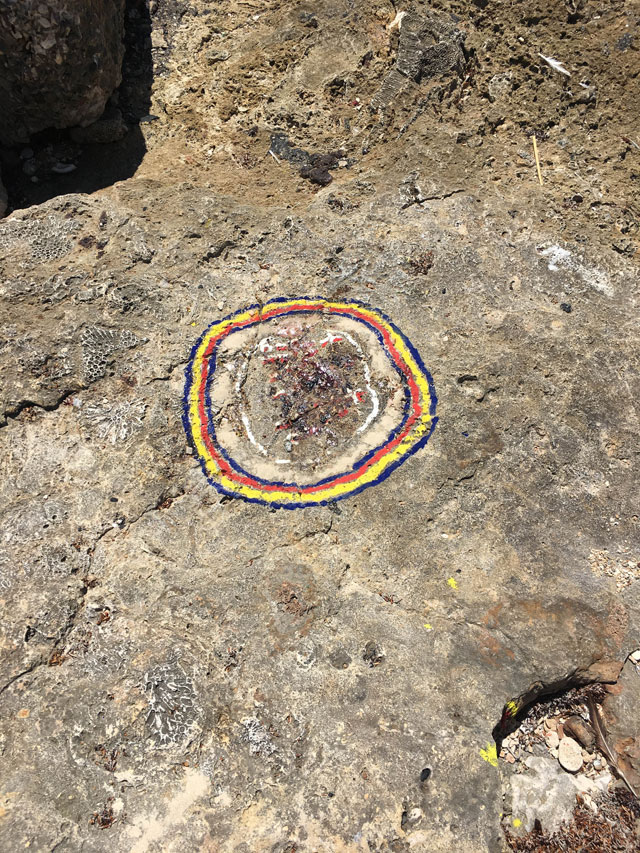
Harold Mendez. Consent not to be a unmarried being, 2017-18. Pigmented inkjet print, 36 × 27 in (91.4 × 68.6 cm). Courtesy the artist and Patron Gallery, Chicago. © 2018 Harold Mendez.
Harold Mendez (b1977, US) lays down the gauntlet of Sin Nombre (2017-18) a tour-de-forcefulness panorama diddled up from a modest, scratched glass slide found in Havana of an everyman rider embarked on an everywhere journey that is rendered movingly immediate with cotton, crayon, graphite and spray enamel on a brawl-grained aluminium plate.
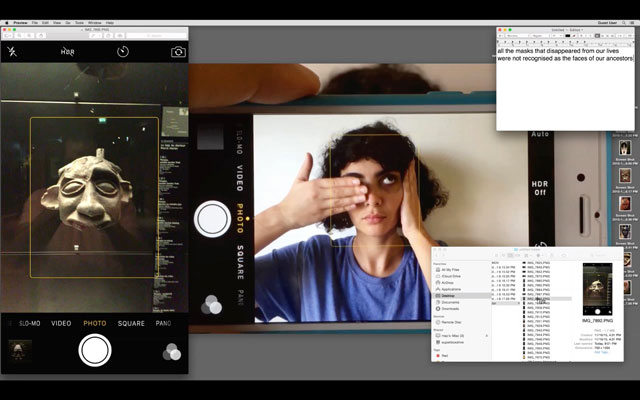
Yazan Khalili. Hiding our faces similar a dancing air current, 2016 (still). Video (colour, no audio), vii min, 30 sec. Courtesy the artist and Lawrie Shabibi, Dubai. © 2018 Yazan Khalili.
Following on from Yayoi Kusama'southward infinity-room meditations and Iván Navarro's downwardly-the-rabbit hole illusions, Yazan Khalili (b1981, Syria) morphs self into soul with a visually challenging computer screen video of a photo of a video of a streamed paradigm of a woman taking a selfie on her iPhone (Hiding Our Faces Like a Dancing Wind, 2014).
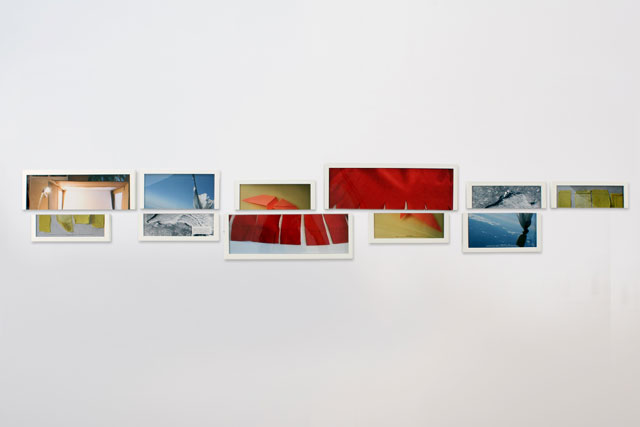
Shilpa Gupta. Untitled, 2014. Pigmented inkjet prints in divide frames, 18 × 103 in (45.vii × 261.6 cm). Courtesy the artist and Galleria Continua, San Gimignano, Beijing, Les Moulins, and Habana. © 2018 Shilpa Gupta.
Best known for interactive installations worked from materials culled from the streets of Mumbai (retrieve crochet-covered bricks and bottles filled with blood that have passed down through a train), Shilpa Gupta (b1976, Bharat) doubles down on the decomposed prototype. Strung out horizontally like misaligned Donald Judds, four Untitled (2014) pigmented inkjet prints depict people whose names have been, or take had to be, changed, their faces cut upward and reassembled to give them new visual identities.
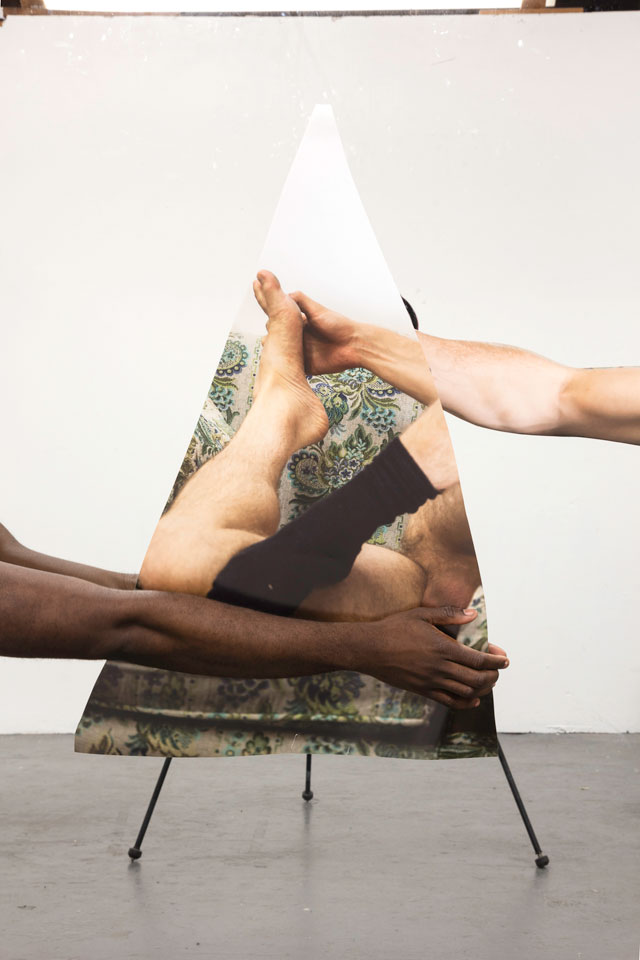
Paul Mpagi Sepuya. Mirror Study (4R2A0857), 2016. Pigmented inkjet print, 51 × 34 in (129.5 × 86.4 cm). The Museum of Mod Art, New York. Fund for the Twenty-First Century. © 2018 Paul Magi Sepuya.
Paul Mpagi Sepuya (b1982, US) may have relocated to Los Angeles, only he sits with his back to the view. Mining an inner landscape, he frames drapery and sourced materials to contrast the emotional impact of charged spaces either filled with, or emptied of, bodies. Providing a resolution of sorts, Mirror Study (4R2A0857) (2016) achieves harmony with a squared composition of black arms thrust through the triangular manus-drawn aeroplane of a tripod to embrace disembodied white limbs.
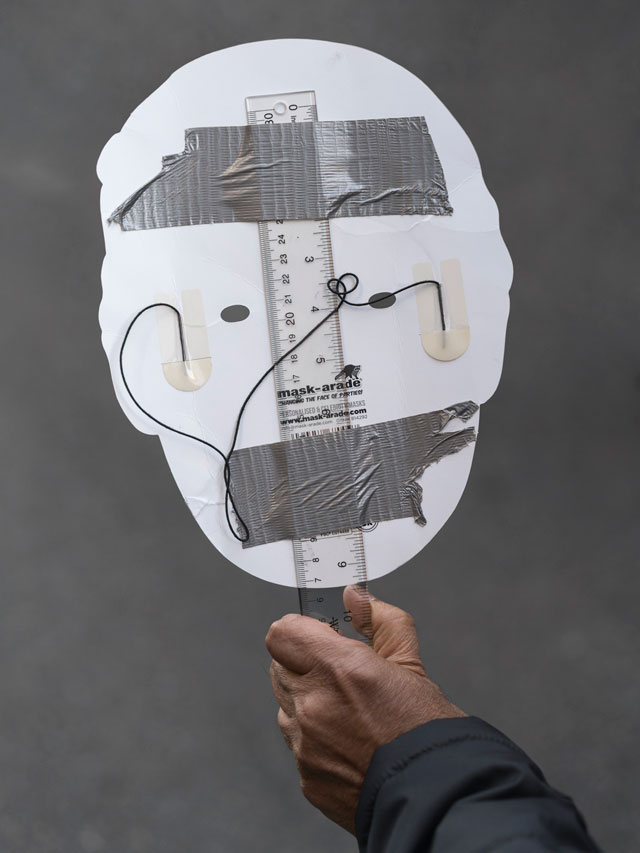
Matthew Connors. Mask in Opposite, 2016. Pigmented inkjet impress, 44 × 33 in (111.8 × 83.8 cm). Courtesy the artist © 2018 Matthew Connors.
In striking contrast, The states artist Matthew Connors' pastoral images of life in North korea subvert the idyll with sly interventions. On shut viewing, a plein-air landscape, Pyongyang (2016), is framed similar a master painting only reframed as a doctored photograph of a fabricated nirvana past a seemingly accidental double exposure that left the photographer'south paw in the image. Unanimous Desire, office of a collective work hung similar a decomposed painting, also conveys emotions that cannot be spoken, simply with a series of built or composed multimedia installations.
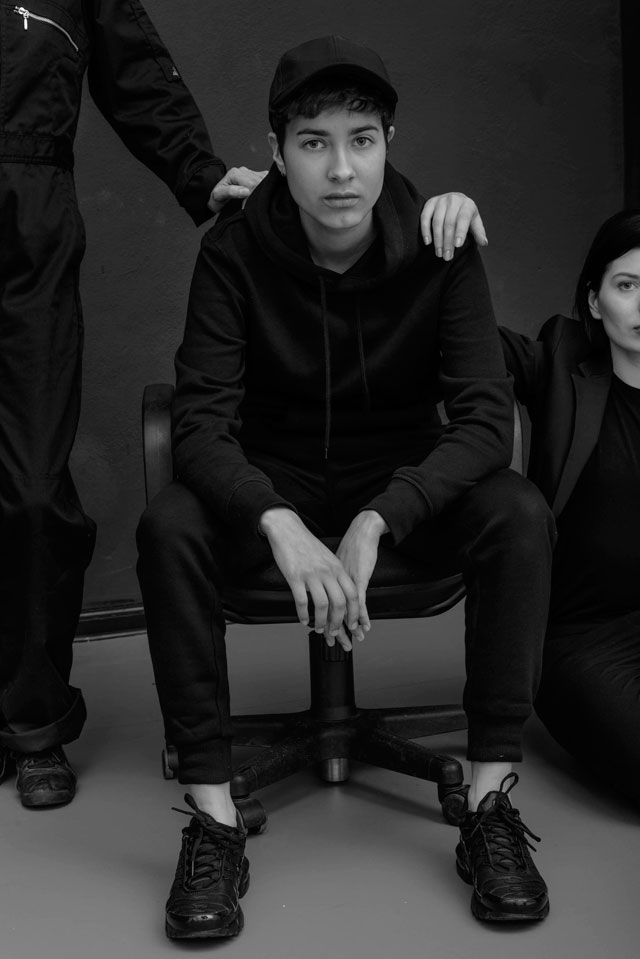
Andrzej Steinbach. Untitled from the series Gesellschaft beginnt mit drei, 2017. Inkjet print, 35 7/16 × 23 five/8 in (90 × 60 cm). Courtesy the artist and Galerie Conradi, Hamburg and Brussels. © 2018 Andrzej Steinbach.
The arresting blackness-and white images by Andrzej Steinbach (German; b1983, Poland), drawn from a serial, Untitled (2016) addresses split identity by juxtaposing black-and-white portraits of two men and a adult female, each cropped to motion the extremities of the 1 on to the next for a Corps Exquis exercise that alternately strips away and adds to our accepted view of humanity.
Engaging visual alchemy, a trio of photo-collages (2018) by Adelita Husni-Bey (b1985, Italy), proposed equally student workshop projections of MoMA's dystopian future in the aftermath of catastrophe, wrest an enigmatic prediction from manipulated simulations of a quattrocento nascency, a biblical parable and a Zurbarán.
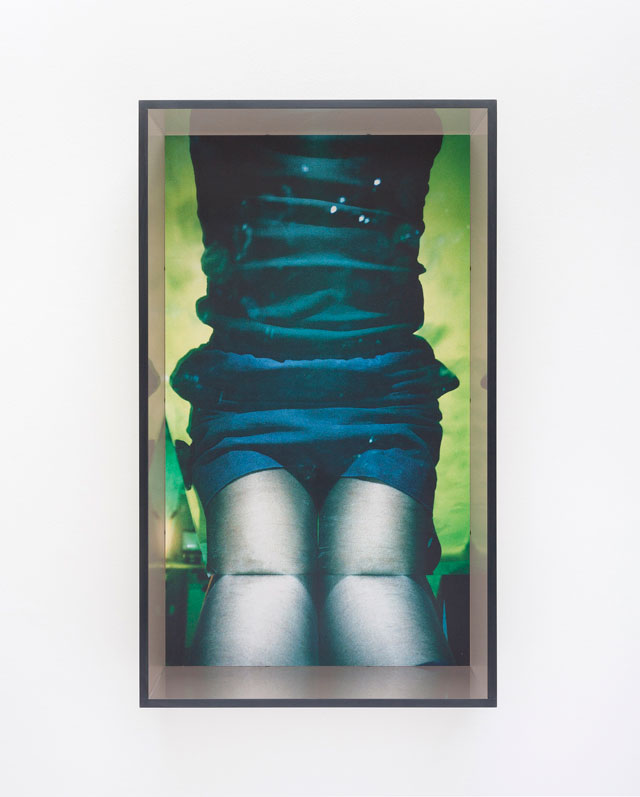
B. Ingrid Olson. Felt Bending, box for standing. 2017. UV printed MDF, PVA size, Plexiglas, screws, 31 1/2 × 18 1/2 × 6 in (80 × 47 × 15.two cm). The Museum of Modern Art, New York. Fund for the Twenty-First Century © 2018 B. Ingrid Olson.
B Ingrid Olson (b1987, Us) startles with surrealist Beuys-inflected UVM-printed pdfs (all 2017) of headless self-portraits girdled, felt-wrapped or sculpted with low-cal and screwed to the wall behind Plexiglas.
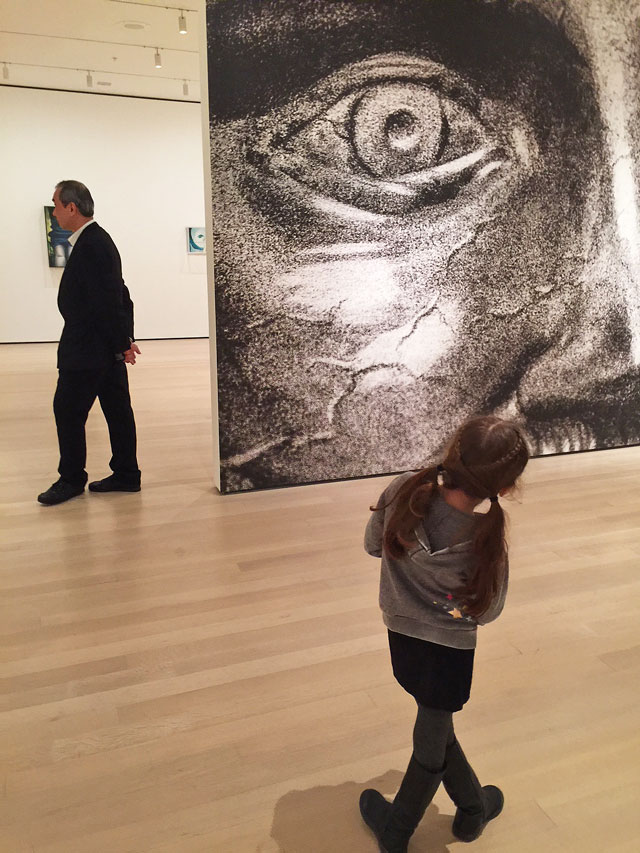
Sofia Borges. Theatre, or Cavern, 2014. UV-printed wallpaper, printed 2018. Installation view. Photograph: Jill Spalding.
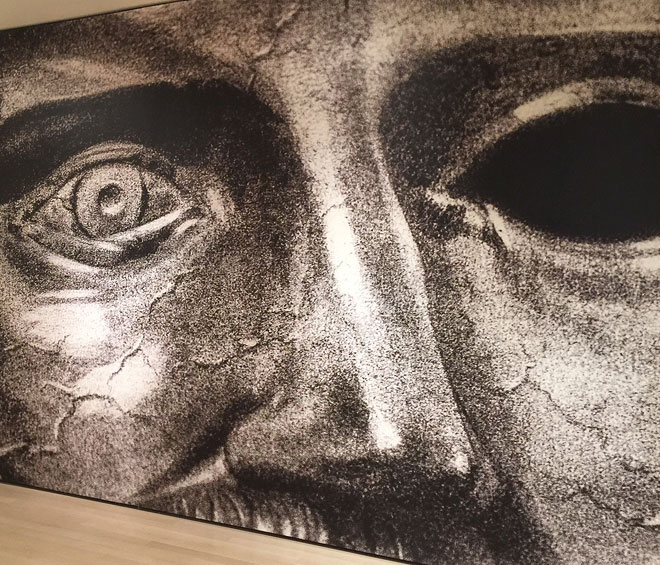
If one artist can exist said to dominate, it is Brazil's Sofia Borges (b1984) with mesmerising landscape-scale, seemingly 3D-printed pigmented inkjet prints of Olmec-dimension rock heads that are so realistic as to command "do not touch" signs. Viewers coming across Theatre, or Cave (2014) step and so far back to absorb its entirety as to occasion collisions with those continuing behind them. Monumentality is "huge" now, of course – seen across disciplines in such efforts as Anselm Kiefer's magisterial installations commissioned for his Warehouse past collector Martin Margulies, and the grandiosity artful triggered by the colossi built for Burning Homo. Merely Borges is later on something of a different club birthday. Arroyo a giant redwood, stand nether the Sphinx, brand a rubbing of a temple frieze and you are, of course, moved by their size, but equally by their texture – the deep materiality of the bark, sand or marble. By suffusing this illusion of texture into a photograph – y'all must exist fully warning to run into that Painting, Brain and Face (2017), is non really a tapestry – Borges has profoundly and irrevocably moved photography beyond reportage, beyond craft, beyond the quick heart and smart idea to a level of creativity that directs idea through hand to produce from a flat image the circuitous emotion that reads as art.
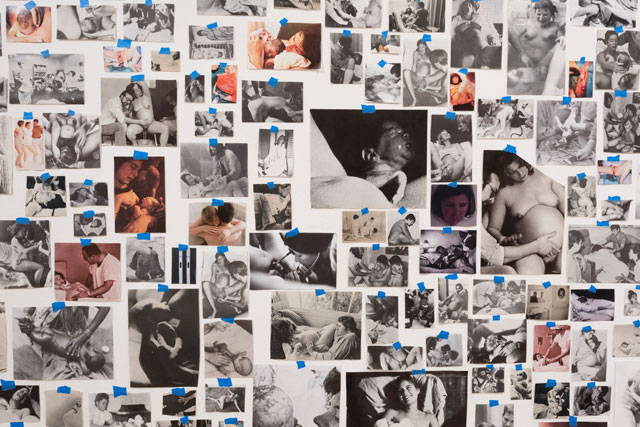
Carmen Winant. My Birth (particular), 2018. Site-specific installation of found images, record. The Museum of Modern Fine art, New York. Photograph: Martin Seck. © 2018 Carmen Winant.
Not all the work selected has been successfully manipulated. And My Nascence (2018, a facile, two-wall compilation of found photographs by Carmen Winant (b1983, US) depicting women closeup in childbirth doesn't even belong here. The two wall-length composites of more than 2,000 tiny "I could have taken them" snaps mined from estate sales, health providers and discarded libraries must have been included more for the testify's theme than its reveal, and then tired is the format that intrigued when showtime peeled off the throwaway photographic camera but that at present, like those unedited photos that collect on your iPhone, tests viewer patience with its drench of undigested information.
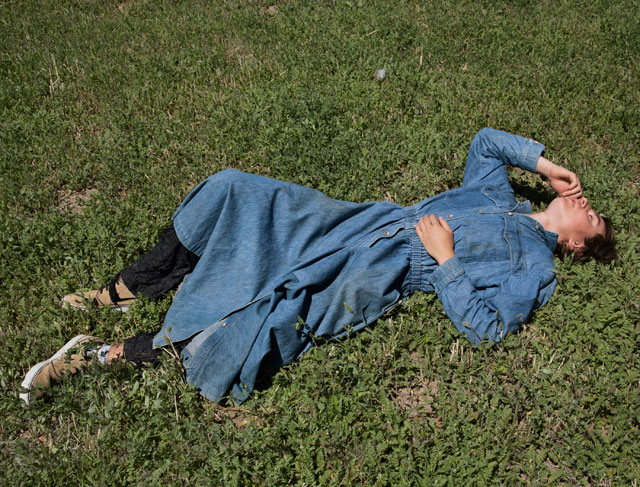
Sam Contis. Denim Dress, 2014. Pigmented inkjet print, 31 five/8 × 41 11/16 in (80.three × 105.9 cm). The Museum of Modernistic Art, New York. Acquired through the generosity of Thomas and Susan Dunn © 2018 Sam Contis.
On the other paw, in context, the gelatin silver prints by veteran photographer Sam Contis (b1982, US), do read every bit a deviation. See, in Denim Dress, how the tranquil American iconography of daughter-sprawled-out-in-field jumps the frame when you realise the girl is a boy; and in Junction 2015, how the mythic forms and long shadows of the American west are worked into surreal compositions that speak every bit poignantly of homo longing as has any sculpture or painting. Which begs the question, have I been request the wrong question? Should I have understood photography equally a High Art all along? Or has this bold new work taken the medium to a identify that the last denier tin no longer deny?
What is certain is that the center, always seeking a rush, volition keep asking more of photographs every bit new technologies seduce. Tomorrow'southward question is how will the artist wrangle from the mail-analogue-computer's elastic neural membrane an image at one time personal and urgently universal? The question for the solar day after tomorrow is shall the photographic conceit of "image" vanish birthday and with it both photograph and the "art of photography"? Meanwhile, visit this uneven but gripping exhibition to meet where MoMA places the vernacular today.
Source: https://www.studiointernational.com/index.php/being-new-photograph-2018-review-moma-new-york
0 Response to "Being New Photography 2018 at Moma New York Art in America"
Post a Comment